Construction and demolition debris collection in Cleveland diverts heavy, non-putrescible renovation refuse away from standard curbside garbage routes, which prohibit building aggregates. A single kitchen gut in an…
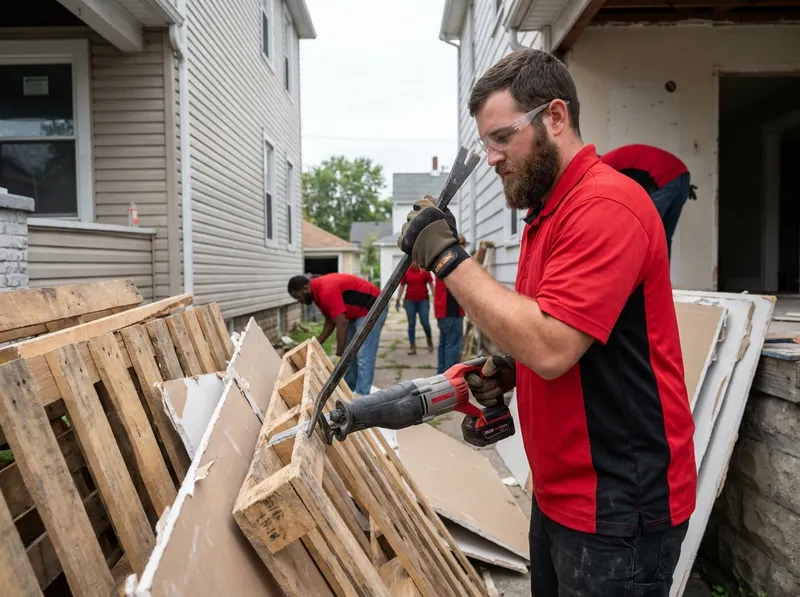
Construction and demolition debris collection in Cleveland diverts heavy, non-putrescible renovation refuse away from standard curbside garbage routes, which prohibit building aggregates. A single kitchen gut in an Ohio City Victorian generates roughly 1,500 to 2,500 pounds of plaster, lath, and decayed subfloor. Placing those loads at the street exposes property owners to municipal citations under Cleveland Codified Ordinance Chapter 551. Dedicated debris collection prevents project work stoppages by clearing physical waste from tight residential driveways and staging zones. Crews drop heavy-duty containers or execute rapid on-site sweeps, placing wooden boards beneath steel wheels to protect aging concrete and asphalt slabs common in Detroit-Shoreway and Tremont from point-load cracking.
Selecting the correct haul-away profile depends on debris density versus bulk cubic yardage. A full bath renovation involving cast-iron plumbing and ceramic tile requires dense-load weight accommodations, whereas an attic expansion in Edgewater generates expansive, low-density insulation and framing cutoffs. If a contractor manages a phased, multi-day gut along Kamm's Corners, an on-site roll-off container provides an uninterrupted workflow for tradesmen. Conversely, if a tight driveway in Old Brooklyn cannot forfeit parking without violating street access, an immediate-load sweep truck clears the pile in 45 minutes, sparing the homeowner from pulling a City of Cleveland street-obstruction permit. The operational trade-off centers on loading labor versus footprint: a roll-off eliminates double-handling debris, while an immediate load keeps the driveway entirely clear overnight.
Logistics across Cuyahoga County hinge on clear transit corridors and strict material segregation. Standard drop-off procedure follows three numbered steps. First, the property owner confirms a clear drop zone with 14 feet of overhead clearance, ensuring delivery arms do not tangle with low-hanging utility lines in Slavic Village or Collinwood. Second, the hauling team stages the container or backs the collection unit directly to the debris site, resting equipment on protective cribbing. Third, the waste is transported to certified processing and transfer stations, such as recovery facilities off Interstate 77 or local solid waste transfer depots, where recyclables like structural steel and clean concrete separate from landfill-bound wallboard. Loads exceeding 4,000 pounds incur additional tonnage costs, making exact estimation essential prior to loading heavy masonry or foundation concrete.
Every job gets a firm, written price after a free on-site visit.
Tell us about your construction & demolition debris collection job in Cleveland and we'll send a clear, written quote, usually the same day.
 BinRush Dumpster Rental